KCE ProcessBook

Welcome!

This site is currently under reconstruction.

In Belgium, cost-effectiveness is one of the criteria used by public authorities to assess applications for reimbursement of medicines and Class 1 medical devices, i.e. products for which the applicant claims added therapeutic value and for which a higher price may be charged. For other interventions as well (surgical procedures, vaccines, disease prevention strategies, screening programmes, etc.), economic evaluations and budget impact analyses provide valuable support for the efficient use of limited resources. This guideline is the result of the second update of the KCE guideline on economic evaluations in health and budget impact analyses. The aim is to improve the relevance, methodological quality, transparency and consistency of these economic evaluations of health interventions in Belgium.

Neyt Mattias, Thiry Nancy, Cleemput Irina. Belgian guidelines for economic evaluations and budget impact analyses: third edition. Method. Brussels. Belgian Health Care Knowledge Centre (KCE). 2025. KCE Reports 400C. DOI: 10.57598/R400C.

  1. the literature review,
  2. the perspective of the evaluation,
  3. the target population,
  4. the comparators,
  5. the analytic technique,
  6. the study design,
  7. the calculation of costs,
  8. the estimation and valuation of outcomes,
  9. the time horizon,
  10. modelling,
  11. handling uncertainty and testing the robustness of the results,
  12. the discount rate.   

The guidelines for budget impact analysis encompass specificities with respect to the target population and the comparator and refers to guidelines for economic evaluation which should also be respected in the budget impact analysis.


KCE Reports 386C (2024)

Classic KCE reports are often time- and resource-consuming, but in a rapidly changing healthcare environment, there is sometimes a need for faster assessments of available evidence. To provide faster scientific answers to pressing healthcare questions, the KCE has developed a new ‘accelerated’ methodology.

Jespers Vicky, Verleye Leen, Costa Elena, Vlayen Joan, Struyf Thomas. KCE Process Note: Research Methods for guidelines – update 2025. Methods. Brussels. Belgian Health Care Knowledge Centre (KCE). 2026. KCE Reports 411. (DOI: 10.57598/R411C)

Rationale

Clinical practice guidelines (named ‘guideline’ for the remainder of this document) are designed to improve the quality of health care and to decrease the use of  unnecessary or harmful interventions. Guidelines play a crucial role in health care by providing evidence-based recommendations for diagnosing, treating, and managing various medical conditions. They help ensure consistency in care, improve patient outcomes, and reduce unnecessary variations in treatment. By synthesising the latest research, complemented with expert opinion and expert consensus, guidelines help healthcare professionals make informed decisions, balancing effectiveness with safety. They also support quality assurance, cost-effective care, and ethical medical practice. 
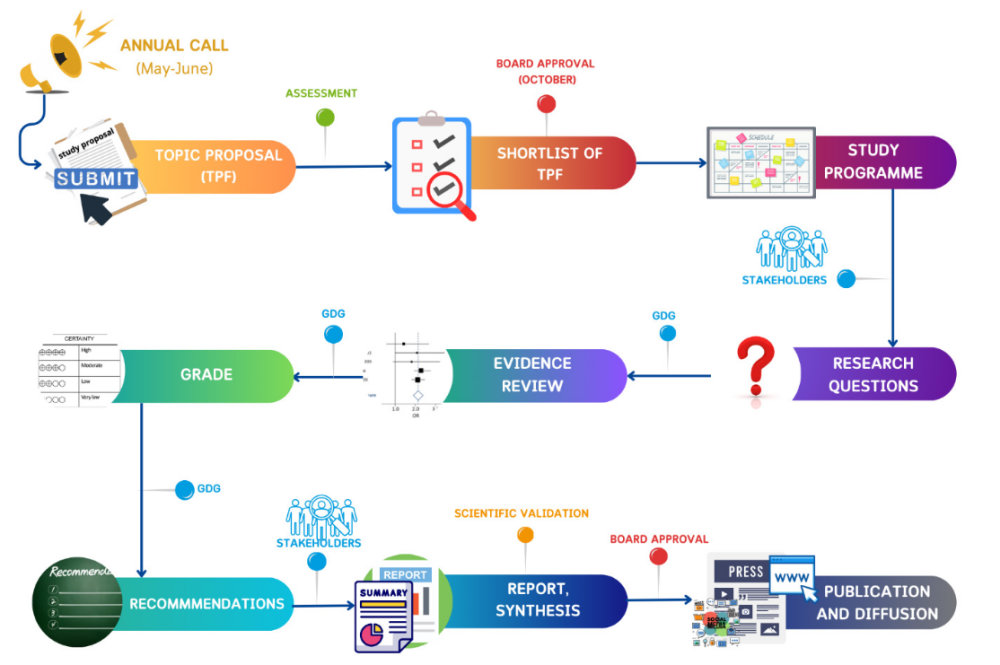
Guidelines are developed through a rigorous and systematic process to ensure they are evidence-based and of high quality. To achieve this aim, a KCE process and methodology guide describes how to approach a new research request to develop a guideline. Figure 1 pictures the steps between the submission of new projects and the publication of KCE reports. The parts of the process typical for a guideline rely on the stringent application of methodology. For a guideline to be of high quality and evidence-based, the methodology has to be kept up to date.

Figure 1 pictures the steps between the submission of new projects and the publication of KCE reports

KCE Reports 408C (2025)

In the context of KCE research, qualitative methods can provide a deeper, more concrete understanding of the topic under investigation than purely quantitative data, as well as valuable insights regarding its wider context. Their aim is not just to describe, but also to obtain more meaningful explanations of a phenomenon. They can also be useful in generating hypotheses. Qualitative research methods are particularly valuable in research on the organisation of healthcare (known as Health Services Research or HSR), but they can also be used in other types of projects like Health Technology Assessments (HTA) or the development of Good Clinical Practice guidelines (GCP).

The first KCE process note on qualitative research methods (QRM) was issued in 2012, as part of a collection of methodological guidance documents aiming to help in-house experts and subcontractors deliver high-quality research based on the best evidence available. It addressed the nature and usefulness of qualitative research and qualitative findings, but also the crucial issue of their quality and validity as evidence.

Thirteen years later, the importance of QRM in the field of health sciences in general and at KCE in particular has considerably increased, as has the underlying methodological basis. The world too has changed over the last decade, not least because of the profound impact of COVID-19 and the spectacular boost it gave to remote and online solutions. This evolution inevitably influenced qualitative research on a practical level, with remote or hybrid meetings or interviews becoming commonplace, but also, more fundamentally, with the increasing use of online data collection techniques. At KCE, COVID-19 also triggered an in-depth reflection on expedited research and reporting (ESRO), the qualitative component of which poses specific challenges.

For all these reasons, the time had come to revise, improve and develop the original process note to include recent evolutions and new experiences, and provide KCE researchers with up-to-date methodological guidance on qualitative research methods.

This new report aims to provide hands-on advice and criteria for the use of QRM in KCE studies, and to broaden the knowledge base about QRM within KCE. It contains some theoretical knowledge on QRM, advice for putting them in practice and (answers to) frequently asked questions to guide decision-making, as well as links to numerous more specific procedures, templates and other resources.

Table of content

  1. Introduction
  2. Literature review
    1. Introduction
    2. Literature review
    3. Meta review: reveiw of review
  3. International comparison
    1. Rationales for international comparisons in HSR research: does an international comparison serve your problem?
    2. Adapt the “set-up” of the international comparison to theproblem you want to address

KCE Reports 340 (2021)

This process note aims at providing guidance on how to involve patients at various stages of a research process. It follows the publication of the Position Paper on Patient Involvement in KCE research in 2019 (KCE Report 320). The process note describes potential barriers and proposes practical solutions to help researchers to actively involve patients in their research projects. This process note is accompanied by a practical guide of animation techniques that may help to involve patients in a practical, effective and pleasant way. These techniques could also be used with other target groups. Both of these publications are living documents: they will be updated based on the future experiences of KCE researchers when involving patients.

Around the world, the tendency is to involve patients in scientific research projects aimed at providing guidance to healthcare policy-makers. Patients, who are faced with the physical, emotional and financial consequences of their illness, have specific knowledge which researchers do not have (or which are not described in the scientific literature). This is what is referred to as “expertise by experience”. It is therefore logical to take their point of view into account. In Belgium, KCE is the first public institution to examine this issue.

Our researchers have studied the scientific literature and consulted the opinions of Belgian experts and institutions similar to KCE in other countries, taking into account the ethical and philosophical aspects associated with patient involvement. We have also discussed and researched the matter internally, questioning our own culture, opinions and experiences. As a result of this in-depth exercise, we have put forward 18 positions on the subject.

Investing in time and in additional resources will be the main challenge for the researchers. They will also have to look closely at the emotional burden that this involvement will represent for patients and researchers, and at the possible conflicts of interest, just as they do for the other stakeholders. The next step will be to develop a methodological guide offering practical recommendations.

Cleemput Irina, Dauvrin Marie, Kohn Laurence, Mistiaen Patriek, Christiaens Wendy, Léonard Christian. Position of KCE on patient involvement in health care policy research . Method. Brussels. Belgian Health Care Knowledge Centre (KCE). 2019. KCE Reports 320. DOI: 10.57598/R320C.

  • procedure_websurvey.pdf
  • limesurvey_kce_manual20201409.pdf
  • Plugin_Delphi_for_Limesurvey_140920.pdf
  • procedure_websurvey.pdf
  • limesurvey_kce_manual20201409.pdf
  • Plugin_Delphi_for_Limesurvey_140920.pdf

  • process_04_template_-_search_strategy_1.doc
  • process_04_template_-_search_strategy_1.odt
  • Process_06_Template_StudiesSelection_20200716.xls
  • KCEProcessbook_Amstar2-checklist.docx
  • Cochrane Collaboration's Risk of Bias Tool.doc
  • Template Risk of Bias tool.doc
  • Template QUADAS 2 tool.doc
  • Cohort studies_template.docx
  • Case-control studies_template.docx
  • AGREEII.pdf
  • evidence tables_final.docx
  • process_04_template_-_search_strategy_1.doc
  • process_04_template_-_search_strategy_1.odt
  • Process_06_Template_StudiesSelection_20200716.xls
  • KCEProcessbook_Amstar2-checklist.docx
  • Cochrane Collaboration's Risk of Bias Tool.doc
  • Template Risk of Bias tool.doc
  • Template QUADAS 2 tool.doc
  • Cohort studies_template.docx
  • Case-control studies_template.docx
  • AGREEII.pdf
  • evidence tables_final.docx

Table of Content

    WHAT IS A RAPID REVIEW?
    WHY ARE RAPID REVIEWS NEEDED?
    DO WE HAVE EVIDENCE THAT RAPID REVIEWS ARE VALID?
    HOW TO PRODUCE RAPID REVIEWS AT KCE?
        SCOPE
        COMPREHENSIVENESS
            Limit the search strategy
            Using a published systematic review as the core document
            Limit textual analysis
        QUALITY CONTROL
            Only one reviewer for title/abstract screening and data extraction
            Limit or eliminate internal or external review of final product (e.g. peer review)
        TRANSPARENT REPORTING
    CONCLUSIONS


Piérart Julien, Léonard Christian, Chalon Patrice, Daue François, Mertens Raf. "Stakeholder Involvement" in KCE working processes. Methods. Brussels. Belgian Health Care Knowledge Centre (KCE). 2012. KCE Reports 174C. DOI: 10.57598/R174C.

Kohn Laurence, Christiaens Wendy. The use of Qualitative Research Methods in KCE studies. Methods. Brussels. Belgian Health Care Knowledge Centre (KCE). 2012. KCE Reports 187C. DOI: 10.57598/R187C.

This report is the result of a major survey conducted among healthcare providers to see how well they use and appreciate the guidelines and how they want them to be improved.

Benahmed Nadia, Adriaenssens Jef, Christiaens Wendy, Paulus Dominique. Towards tailoring of KCE guidelines to end-users' needs. Method. Brussels. Belgian Health Care Knowledge Centre (KCE). 2017. KCE Reports 284. DOI: 10.57598/R284C.

Camberlin Cécile, Obyn Caroline, Neyt Mattias. Transversal Budget Impact Analysis. Method. Brussels. Belgian Health Care Knowledge Centre (KCE). 2023. KCE Reports 369C. DOI: 10.57598/R369C.

  • procedure_websurvey.pdf
  • limesurvey_kce_manual20201409.pdf
  • Plugin_Delphi_for_Limesurvey_140920.pdf
  • procedure_websurvey.pdf
  • limesurvey_kce_manual20201409.pdf
  • Plugin_Delphi_for_Limesurvey_140920.pdf